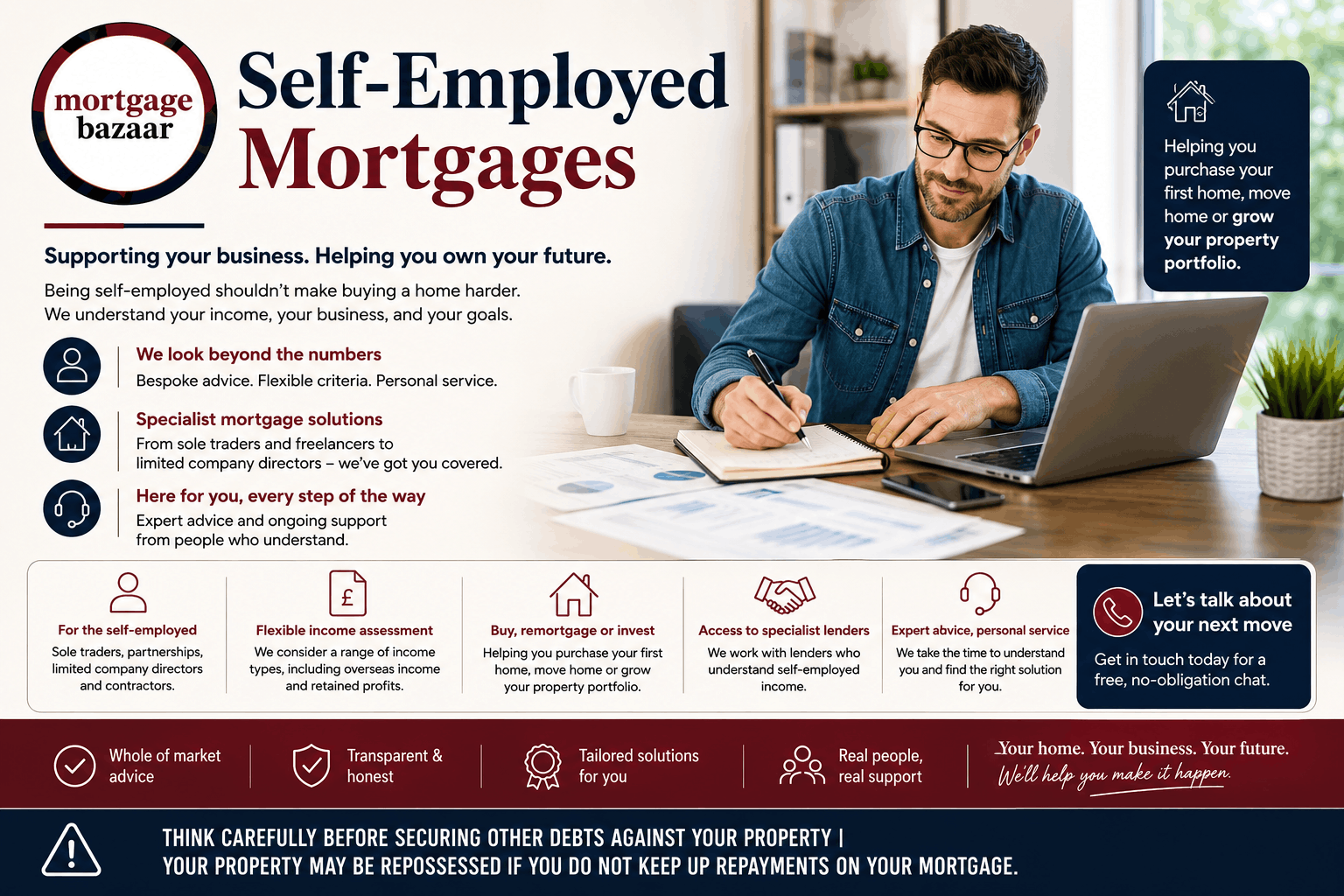
eSelf-employment is a flexible and independent lifestyle, but mortgage applications are considered to be much more difficult. The positive side of the story is that lenders are becoming more accepting of freelances, contractors, sole traders and limited company directors, provided you can provide them with proof of a steady income. Self-Employed Mortgages
At Mortgage Bazaar, we are here to assist self-employed people to discover mortgage solutions that are suitable to their financial scenarios. If you are a first-time buyer, moving house or remortgaging, it’s important to know what self-employed mortgages are and how they work, to maximize the chances of being approved.
What Is a Self-Employed Mortgage?
A self-employed mortgage is not a mortgage that is available. It is just a normal mortgage provided to the people who are self-employed and do not have regular employment.
The loans that lenders offer to borrowers who are self-employed are evaluated differently because income may vary from one year to the next. They do not use payslips to assess ability to pay, but instead check business accounts, tax returns, and other financial records.
Who Is Considered Self-Employed?
When applying for a loan, most lenders will define self-employed as someone who owns at least 25% of a business or derives the higher percentage of income from a business.
This includes:
- Sole traders
- Freelancers
- Contractors
- Limited company directors
- Business partners
- Consultants
- Self-employed professionals
Documents You’ll Need for a Self-Employed Mortgage
If you get your paperwork ready ahead of time, it can help make the application process much quicker.
The following items are common documents to include:
- SA302 Tax Calculations
- Tax Year Overviews
- Accounts for at least the last two to three years
- Business Bank Statements
- Personal Bank Statements
- Proof of Identity
- Proof of Address
- Evidence to Support Your Deposit.
Some lenders will accept an applicant with only one year’s worth of trading history, whereas others require two years or more.
How Lenders Assess Self-Employed Applicants
Mortgage lenders evaluate several factors before making a decision.
They usually consider:
- Annual income
- Business profits
- Income stability
- Credit history
- Existing financial commitments
- Deposit amount
- Affordability calculations
- Business performance
The stronger your financial profile, the better your chances of securing competitive mortgage rates.
Benefits of Getting a Self-Employed Mortgage
There are many benefits to selecting a lender that suits your particular needs.
Benefits of selecting an appropriate lender include:
- Getting a competitive interest rate on your mortgage
- Flexible choice of loans
- Fixed or adjustable loans
- Opportunity for first-time buyers
- Accredited purchases by landlords
- Options available for refinancing and home equity loans
- Ability to borrow more money based on higher earnings
- Professional assistance when applying for mortgage loans.
Tips to Improve Your Mortgage Approval Chances
Here are the Top 5 Ways to improve your mortgage application:
1. Stay up to date with your financial accounts by maintaining accurate documentation that shows the stability of your business.
2. Work on your credit score by paying bills on time, as well as reducing outstanding debts (e.g., credit card balances) prior to applying for a loan.
3. Save up a larger down payment, as this will result in a better interest rate and give lenders more confidence.
4. Avoid complications resulting from personal financial changes (such as taking on new debt or changing your business organization) directly before applying.
5. Get in touch with mortgage consultants who work specifically with self-employed people; they know which lenders/capital sources are most open to working with them.
Common Challenges for Self-Employed Borrowers
Even if it’s possible to obtain a mortgage, applicants may encounter obstacles, including but not limited to:
- Variable Annual Income
- Recently Established Business
- Limited Trading History
- Complicated Company Structures
- Seasonal Income
- Inconsistent Profits
Talking with a knowledgeable mortgage advisor would help find lenders matching your needs.
Why Choose Mortgage Bazaar?
At Mortgage Bazaar, we understand that every self-employed applicant has a unique financial situation.
Our experienced advisers help you:
- Compare mortgage options
- Understand lender requirements
- Prepare your application
- Improve approval chances
- Find competitive mortgage deals
- Receive expert guidance throughout the process
Whether you’re a freelancer, contractor, sole trader, or company director, our team works to make your mortgage journey simple and stress-free.
Final Thoughts
Obtaining a mortgage as a self-employed individual can be done easily with preparation & help from professionals. The steps to increase your mortgage approval chances include getting your financials in order, fixing up your credit score and working with an adaptable lender that understands self-employed income.
At Mortgage Bazaar, we help self-employed, freelancer, contractor, and business owners with their mortgage solutions. Connect with our team now to start your home-buying process with confidence.
Ready to unlock the potential in your current home?
Contact the expert team at Mortgage Bazaar today for a tailored strategy session. We will help you run the numbers and find the perfect mortgage path for your double-move.
WhatsApp us: +44 7760747504
Email: nikhil@mortgagebazaar.co.uk
Visit us:www.mortgagebazaar.co.uk
Disclaimer: THINK CAREFULLY BEFORE SECURING OTHER DEBTS AGAINST YOUR PROPERTY | YOUR PROPERTY MAY BE REPOSSESSED IF YOU DO NOT KEEP UP REPAYMENTS ON YOUR MORTGAGE.
Visit us:
FAQs
1. Can I get a mortgage if I’m self-employed?
Yes. Most lenders offer mortgages to self-employed applicants provided you can demonstrate a stable income and meet their affordability requirements.
2. How many years of accounts do I need?
Many lenders prefer two years of accounts, although some may accept applicants with only one year of trading history depending on their overall financial profile.
3. Do self-employed people pay higher mortgage rates?
Not necessarily. Mortgage rates are based on affordability, credit history, deposit size, and lender criteria—not simply on being self-employed.
4. Can freelancers qualify for a mortgage?
Yes. Freelancers can qualify by providing evidence of consistent income, tax returns, bank statements, and any additional documents requested by the lender.
5. How much deposit do I need?
While some lenders may accept deposits as low as 5%, having a larger deposit can improve your chances of approval and help you secure better interest rates.
6. Why should I use Mortgage Bazaar?
Mortgage Bazaar specialises in helping self-employed individuals navigate the mortgage process. Our experienced advisers compare lenders, explain your options, and work to find a mortgage that best fits your financial circumstances.
Leave a Reply