
For many in the UK, the term “adverse credit” feels like a financial life sentence. Whether it was
a missed mobile phone bill during a house move, a period of illness leading to credit card
defaults, or more serious events like a County Court Judgement (CCJ) or bankruptcy, the result
is often the same: the fear that the dream of owning a home is over.
At Mortgage Bazaar, we see things differently. We believe that your past financial challenges
should not dictate your future stability. As we move through 2026, the UK mortgage landscape
has evolved. Specialist lenders are increasingly looking at the “why” and “when” of your credit
history, rather than just the “what.”
In this guide, we’ll explore how you can secure a mortgage even with adverse credit and why
2026 might be the best time to start your journey.
What Exactly is Adverse Credit?
Adverse credit (often called “bad credit”) is simply a record on your credit file that indicates a
break in your financial commitments. Lenders view these as signals of risk. Common forms of
adverse credit include:
- Missed or Late Payments: Even a single missed utility or credit card payment.
- Defaults: When a lender closes your account because you haven’t paid for several months.
- County Court Judgements (CCJs): Legal orders issued when you fail to repay a debt.
- IVAs and DMPs: Formal or informal debt management arrangements.
- Bankruptcy: The most severe form of adverse credit, which stays on your file for six years.
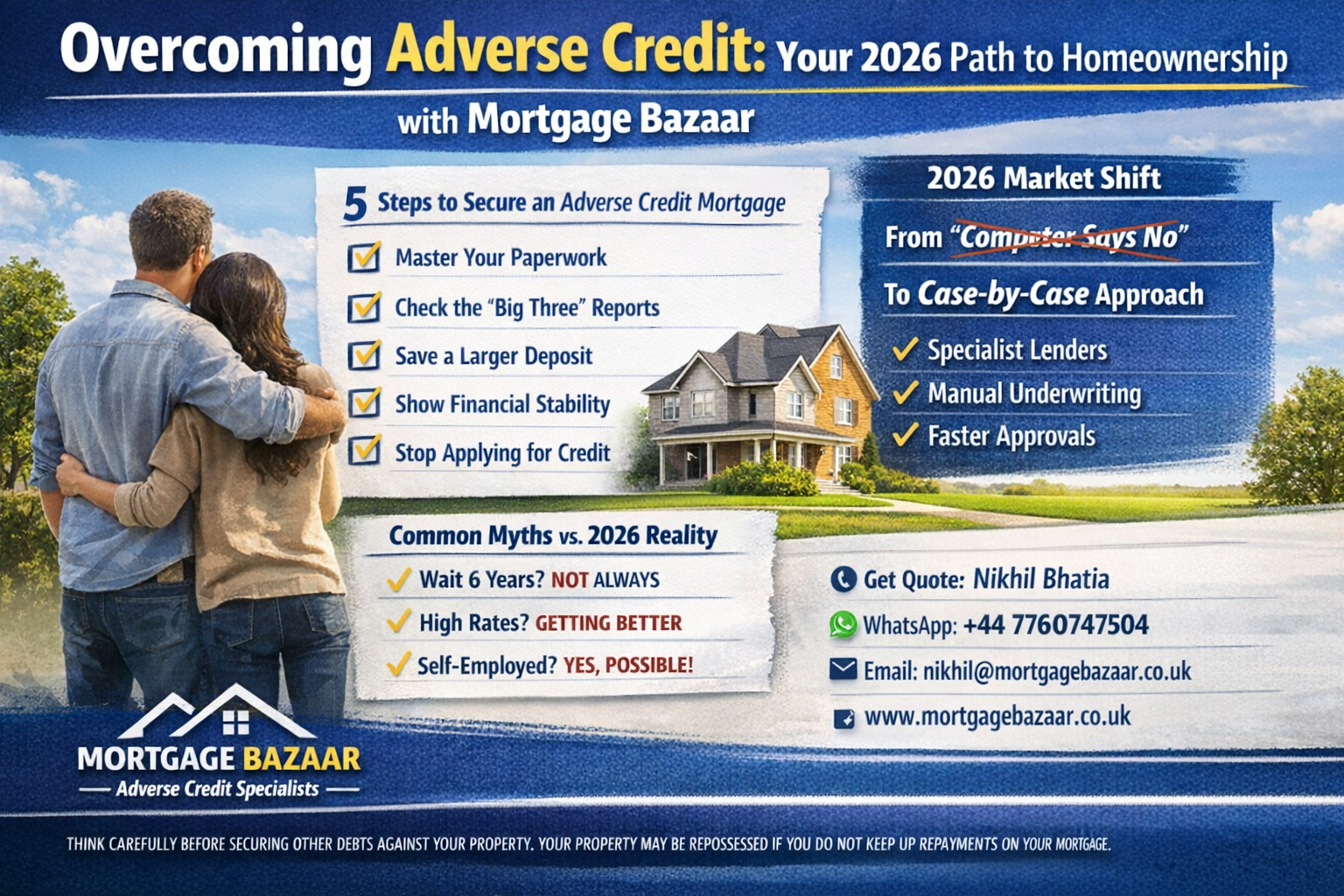
The 2026 Market Shift: From “Computer Says No” to
Case-by-Case
In previous years, high-street banks used rigid automated systems. If a CCJ appeared on your
file, your application was instantly declined.
However, in 2026, we are seeing a rise in specialist lenders who prioritize manual
underwriting. These lenders don’t just look at a score; they look at your current affordability and
your recent financial behavior. If you can show 12 to 24 months of “clean” credit following a
period of difficulty, the doors to homeownership may be wider open than you think.
5 Steps to Securing an Adverse Credit Mortgage
- Master Your Paperwork
Precision is everything in 2026. Lenders are cross-referencing documents more aggressively
than ever.
- Action: Ensure your bank statements match your declared outgoings. Avoid “irregular” cash withdrawals or unexplained transfers in the three months leading up to your application.
2. Check the “Big Three” Reports
Don’t just check one credit app. Lenders use different agencies.
- Action: Download your reports from Experian, Equifax, and TransUnion. Check for errors. An “unsatisfied” CCJ that you actually paid off can be the difference between an approval and a decline.
3. Save a Larger Deposit
With adverse credit, you are seen as a higher risk. You can offset this risk by bringing more “equity” to the table.
- Action: While 5% deposits exist, aim for 15% to 25% if your credit is severely impaired. This gives you access to lower interest rates and a wider pool of specialist lenders.
4. Stability is Your Best Friend
Lenders want to see that the “storm” has passed.
- Action: Try to stay with the same employer for at least 12 months. Ensure you are on
the Electoral Roll at your current address. These small markers of stability build a
lender’s confidence in your reliability.
5. Stop Applying for Credit
Every “Hard Search” on your file can lower your score.
- Action: If you’ve been rejected by a high-street bank, stop. Do not apply elsewhere immediately. Multiple rejections in a short window can make you look desperate for credit, which is a major red flag for underwriters.
Common Myths vs. 2026 Reality
Myth: “I have to wait 6 years for my credit to clear.” Reality: Many specialist lenders will
consider you just 1 to 2 years after a default or CCJ, provided your recent history is flawless.
Myth: “Interest rates will be double the market average.” Reality: While rates for adverse credit
are higher, the gap is narrowing. Furthermore, many clients take a 2-year fixed deal to get onto
the ladder, improve their score through on-time payments, and then “bridge” over to a standard
high-street rate once their credit has recovered.
Myth: “I can’t get a mortgage if I’m self-employed with bad credit.” Reality: This is a specialty of
ours at Mortgage Bazaar. We work with lenders who assess self-employed income and adverse
credit simultaneously, offering a holistic view of your business’s health.
Why Use Mortgage Bazaar for Adverse Credit?
Navigating the sub-prime or “specialist” market on your own is nearly impossible. Many of the
lenders who accept adverse credit do not deal directly with the public—they only work through
accredited brokers.
By choosing Mortgage Bazaar, you gain:
- Market-Wide Access: We scan over 200 lenders to find the one whose “risk appetite” matches your specific history.
- Expert Packaging: We know how to present your “story” to an underwriter. We explain the context of your past issues to turn a “Maybe” into a “Yes.”
- Honest Advice: If you aren’t ready yet, we won’t let you waste money on fees. We will give you a roadmap to get “mortgage-ready” over the next 6 to 12 months.
Your Future Starts Today
Adverse credit is a chapter in your financial book, not the end of the story. Whether you are a
first-time buyer, looking to remortgage to consolidate debt, or an investor with a complex history,
We have the tools to help.
Don’t let a credit score stand in the way of your home.
- Get Quote: Nikhil Bhatia
- WhatsApp: +44 7760747504
- Email: nikhil@mortgagebazaar.co.uk
- Website: www.mortgagebazaar.co.uk
Disclaimer: THINK CAREFULLY BEFORE SECURING OTHER DEBTS AGAINST YOUR
PROPERTY | YOUR PROPERTY MAY BE REPOSSESSED IF YOU DO NOT KEEP UP
REPAYMENTS ON YOUR MORTGAGE.